
- All
- Product Name
- Product Keyword
- Product Model
- Product Summary
- Product Description
- Multi Field Search
Language
Views: 0 Author: Site Editor Publish Time: 2026-01-26 Origin: Site


—Starting from the "First Step" of Dye Bath
In the dyeing process, many problems, seemingly caused by dyes, processes, or equipment, often ultimately relate to whether the dye bath can successfully contact and penetrate the fiber. The key auxiliary agent for solving this "first step" is the penetrating agent.
While penetrating agents themselves do not participate in color development, they play an irreplaceable role in dyeing efficiency, leveling, and finished product stability. Especially in the current context of pursuing stable production, energy conservation, and high consistency, the importance of penetrating agents is increasingly prominent.
Whether it's the waxy layer on the surface of cotton fibers, the scaly structure of wool fibers, or the hydrophobicity of synthetic fibers like polyester and nylon, all these factors create natural barriers to the dye liquor
Penetrating agents significantly reduce the surface tension of the dye liquor, allowing it to spread rapidly across the fiber surface, forming a continuous and uniform water film. This allows dye molecules to fully contact the fibers. This seemingly simple step determines whether subsequent dyeing can proceed smoothly.
On tightly structured substrates such as yarn packages, high-density fabrics, and heavy fabrics, if the dye liquor only remains on the surface, it easily leads to the problem of "ring dyeing," where the surface is colored while the interior remains lighter.
Suitable penetrants help the dye liquor carry the dye, penetrating along fiber capillaries and fabric gaps to achieve uniform dyeing from the surface inwards, thereby improving color depth and color fastness.
During the dyeing process, problems such as uneven dyeing, color streaks, and uneven color distribution are often not caused by the dye itself, but by inconsistent wetting and penetration.
Penetrating agents ensure uniform contact of the dye liquor with all areas of the fabric (including seams, folds, and tightly woven areas), creating conditions for uniform dye adsorption. This is fundamental to controlling color difference and improving batch stability.
When the dye liquor penetrates faster, the dye diffuses more fully, and the dyeing time can naturally be shortened. At the same time, improved evenness also means a lower rework rate, resulting in significant savings in water, electricity, steam, and dye consumption, which is especially important for large-scale production.
Natural Fibers (Cotton, Linen, Wool, Silk): In pretreatment and dyeing processes, penetrants are used to overcome natural obstacles such as waxes, lipids, and sericin.
Synthetic Fibers (Polyester, Nylon, etc.): Highly hydrophobic, especially in high-temperature, high-pressure dyeing, requiring heat-resistant, low-foaming penetrants to assist in wetting and dispersion.
Blended Fabrics (T/C, T/R, etc.): Require even higher compatibility with penetrants, needing to accommodate different fiber systems to ensure consistent overall color.
Cone dyeing: Penetration ability directly affects the color difference between inner and outer layers.
Garment dyeing: Helps the dye penetrate into "dead corners" such as seams and folds.
Cold pad-batch dyeing: Under low-temperature conditions, the penetrant almost determines whether the dye can effectively penetrate the fiber.
Knitted fabric dyeing: Low-foaming penetrants can avoid foam affecting circulation and tension stability.
Heavy fabric dyeing: Such as denim, canvas, and tent fabric, which have higher requirements for penetration performance.
Pretreatment (desizing, scouring, bleaching)
Pretreatment dyeing of waterproof or coated fabrics
Pretreatment for digital inkjet printing, controlling ink droplet spreading and diffusion.
Anionic: Strong wetting power, resistant to hard water
Nonionic: Low foaming, acid and alkali resistant, good compatibility
Compound: Combining multiple properties, more suitable for complex processes
With environmental regulations and process upgrades, penetrants are developing in the following directions:
Multifunctional (wetting + penetration + leveling)
Low-temperature and high-efficiency (suitable for energy-saving dyeing processes)
Green and environmentally friendly (APEO and PFOS free, easily biodegradable)
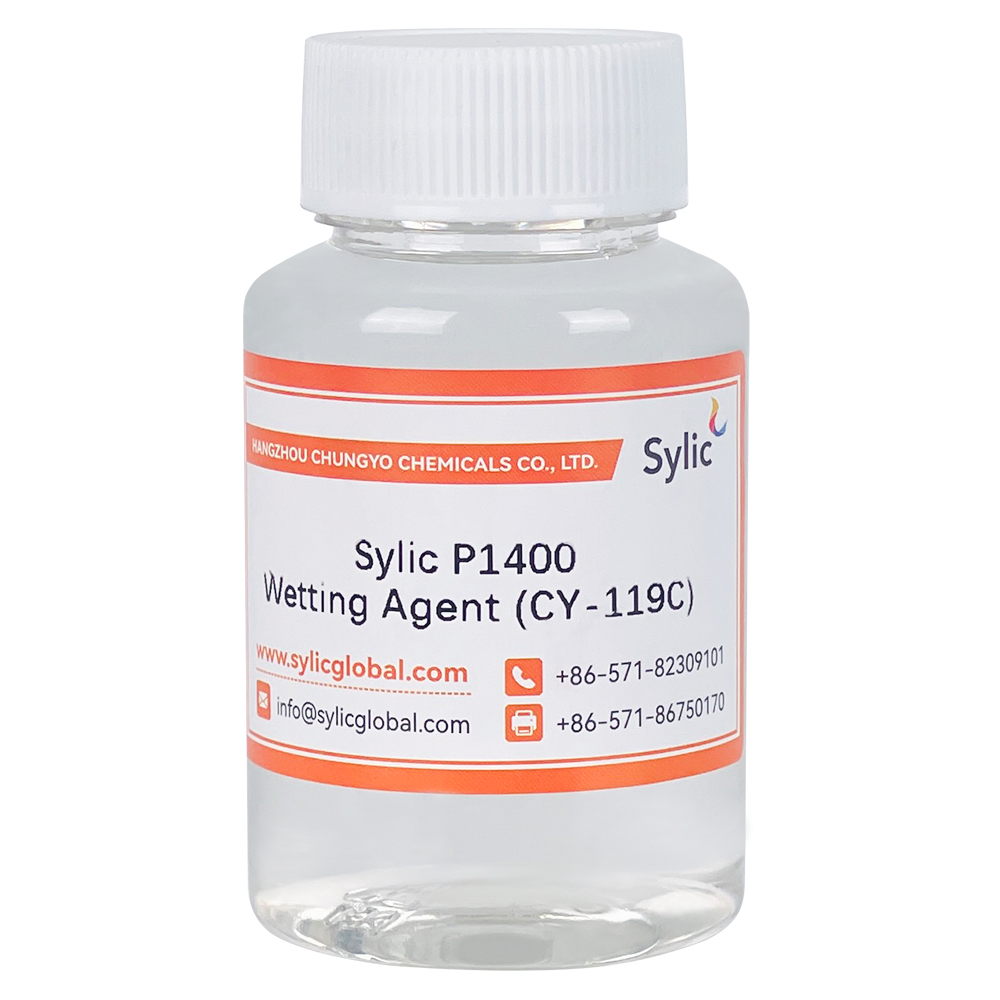
In actual production, not all products labeled as "penetrating agents" truly solve the penetration problem. Many auxiliaries can only improve wetting but are insufficient to propel the dye liquor further into the fiber interior.
Sylic P1400 is a wetting and penetrating agent that possesses both wetting and deep penetration functions.
During the dyeing process, Sylic P1400 can rapidly reduce the surface tension of the dye liquor, allowing the dye liquor to quickly and evenly wet the fiber surface. Furthermore, its molecular structure facilitates the continuous penetration of the dye liquor into the fiber capillaries and the internal structure of the fabric, ensuring that the dye not only "spreads out" but also "penetrates" effectively.
It is this synergistic effect of "wetting first, then penetrating" that makes Sylic 119C particularly stable in the following applications: dyeing of packaged yarns and high-density fabrics; dyeing of heavy fabrics and denim fabrics; garment dyeing and fabrics with complex structures; cotton, polyester, nylon and their blends.
In practical use, Sylic P1400 helps reduce color difference between the inside and outside, reduces the risk of uneven coloring, and improves batch-to-batch dyeing consistency.


